40% of Gen Z say that they wish social media had never been invented.1 This is the generation that grew up online, yet they’re bricking their phones to avoid doomscrolling and rediscovering the joys of IRL. In fact, 63% of Gen Z adults now intentionally unplug—the highest rate of any generation.2 That’s a shift that marketers can’t afford to ignore.

Gen Z wants help with fuelling their lives, not filling their feeds
But here’s the thing—this isn’t a story about a generation abandoning technology altogether. Because they’re not. They’re abandoning the parts of it that waste their time. Gen Z wants their time online to be in service of their lives offline. Not a distraction from it, but a bridge to it. And we’re seeing this intent play out on our own platform.
On Pinterest, we watch intent signals every single day, and we’re seeing year-on-year jumps in searches such as ‘things to do instead of scrolling’ +365%,3 ‘analogue aesthetic’ +260% and ‘dumb phone’ +150%.4 Plus, there’s been an uptick in searches for offline inspiration such as ‘travel sticker collection display ideas’ +74%, ‘coffee station ideas party’ +624% and ‘bedazzle headphones’ +1,233%.5
things to do instead of scrolling
+365%analogue aesthetic
+260%dumb phone
+150%travel sticker collection display ideas
+74%coffee station ideas party
+624%bedazzle headphones
+1,233%These signals point to a broader shift: people still want inspiration and ideas, but they want them to lead somewhere real. It’s not just about switching off phones, but about using them to live a more meaningful life. The problem is, most online experiences aren’t built for that. They’re built to keep people scrolling.
When people are passively scrolling, ads don’t land
Research shows that 44% of the time, when people go online, they get sucked into scrolling and end up somewhere they didn’t intend to be.6 At Pinterest, we have a name for this: the loop.
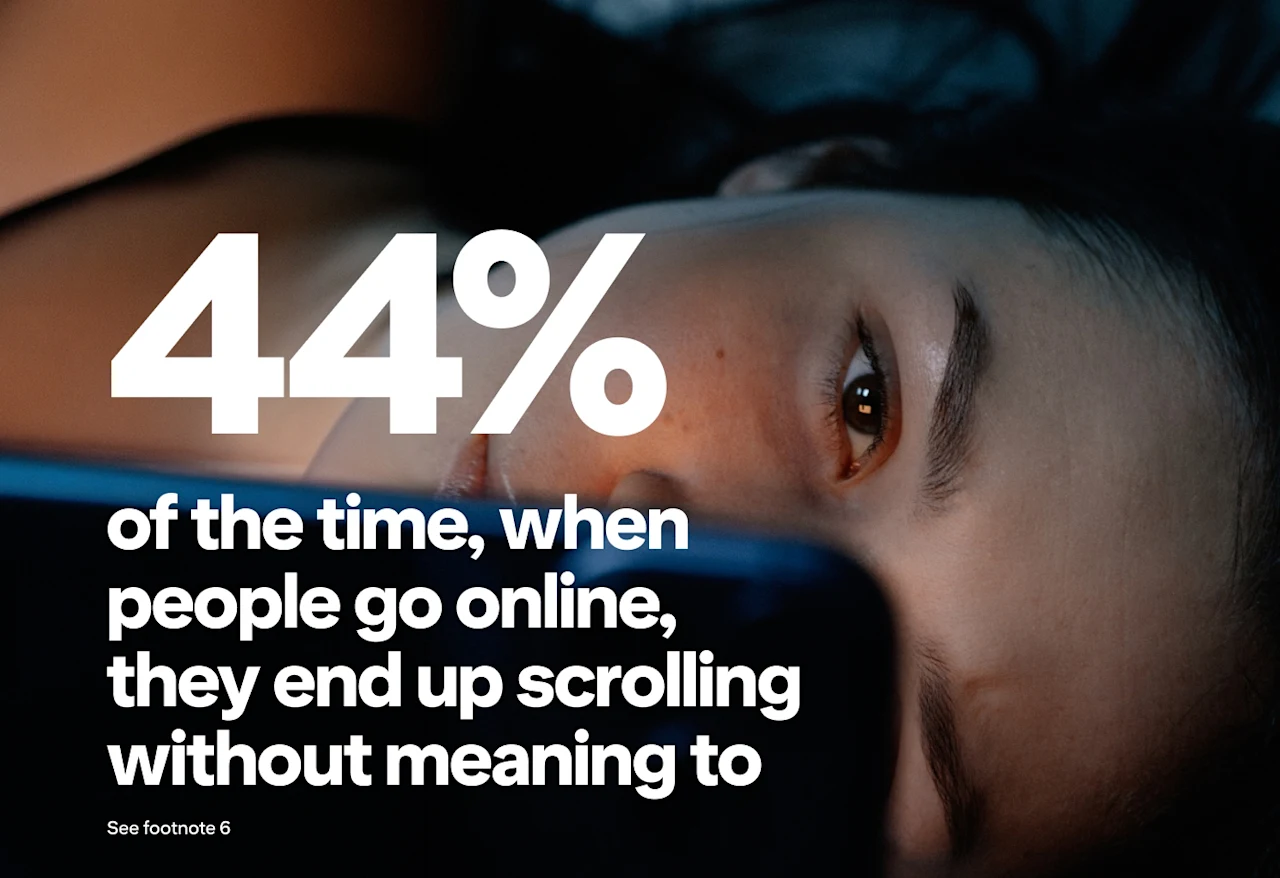
When people are stuck in the loop, passively scrolling, they’re browsing a continuous feed without a clear goal or time limit. And in this context, ads don’t land—they become part of the scroll, and are more likely to be ignored than acted upon.6
But when people are in a more intentional mode online, they’re using technology to help them take action and make decisions in their real lives. In action mode, brands are less likely to be ignored, and more likely to be purchased, trusted and remembered.6
In a world full of infinite choice and shrinking attention, where AI largely decides what gets surfaced and what gets skipped, reach and receptivity are not the same thing. And while capturing attention is still part of your job as a marketer, connecting with people in action-oriented moments is how you move from being seen to being wanted.
So what do you do, as a marketer?
Don’t reinforce the loop. Design the exit.
Instead of asking, ‘How do I capture attention?’, ask, ‘How do I ignite intention?’ Help people to find what they need, quickly and confidently, and get them back to the business of living.
Pinterest is where this already happens, by design. We’ve engineered our platform for time well spent. Meaning, instead of building to keep people scrolling, we’re building for the person: what they want to find, what they need to feel and what they’re actually trying to do. And that’s why Gen Z is our largest, fastest-growing demographic, making up over half of our user base.7
We believe that designing the exit can be applied broadly—across your whole marketing strategy and across platforms. It comes down to three key principles:
1. Open the door
Show that your brand makes a fuller life possible. Make the hero your audience’s world, not your product or service. Your value lies in helping them to see a vivid, specific version of their life that your brand can unlock. It’s not just about selling your product, but about opening possibilities.
Travel inspiration often lives in the gap between ‘some day’ and ‘book it’—and for many people, that gap can feel enormous. Working with Pinterest, Virgin Australia created a series of premium travel video ads designed to spark the imagination and close that distance.
Collage-style visuals helped people to feel the arrival before they’d even left. Even the CTA was ‘Live it’, rather than ‘Book it’. Those two words turned a transaction into an experience worth stepping into.
2. Ignite their intention
If opening the door is inspiring your audience with possibilities, igniting intention is about helping them get to a decision. This is the messy middle of the funnel and the toughest part of a campaign to land. You can win this phase of the journey by helping people to see how your products or services offer a concrete path to realising their vision.
So instead of vague inspiration, give them personalised options, guidance and next steps so they can not only picture the real-world moment that you’ve unlocked, but also see exactly how to get there. The more specific the better: the exact recipe and shopping list, the full outfit with links, the step-by-step room plan.
3. Set them free
Lastly, set them free. This is where advertisers need to be brave. Once people have found what they’re looking for, let them go. Don’t trap people in the experience. Let your brand do its job, and then send them back into their life having found what they were looking for.
Starbucks Mexico did this ahead of the 2025 festive season. They reframed their café as the place where festive connection actually happens—and then built something to make it real. They created an add-to-calendar Pin extension with a pre-filled invitation, ready to send to a friend or family member, with a time and a place already set. Rather than reward the loop, Starbucks created a clear pathway out of it.
Be a bridge to something real
Open the door, ignite their intention and set them free. That’s what it means to design the exit.
More than ever, people want their time online to mean something and to be in service of the lives that they’re actually trying to live. This shift isn’t about wanting less from technology—it’s about wanting more from it. More relevance, more utility and a path to the things that actually matter.
For marketers, this means reaching people ready for action, not distraction, and Pinterest is the platform to do it. 640 million people come to Pinterest every month8 to find what they’re looking for, then get back to their lives. That’s what we’ve always been about, and it’s why Pinterest is seen as the most action-oriented social platform, with 69% of monthly users saying that Pinterest leads to real-world decisions, big and small.6 We’re a platform that moves people towards a life they love, and your brand can be the bridge to make it real.
Find out how your brand can fuel a life, not just fill a feed, on Pinterest.

